

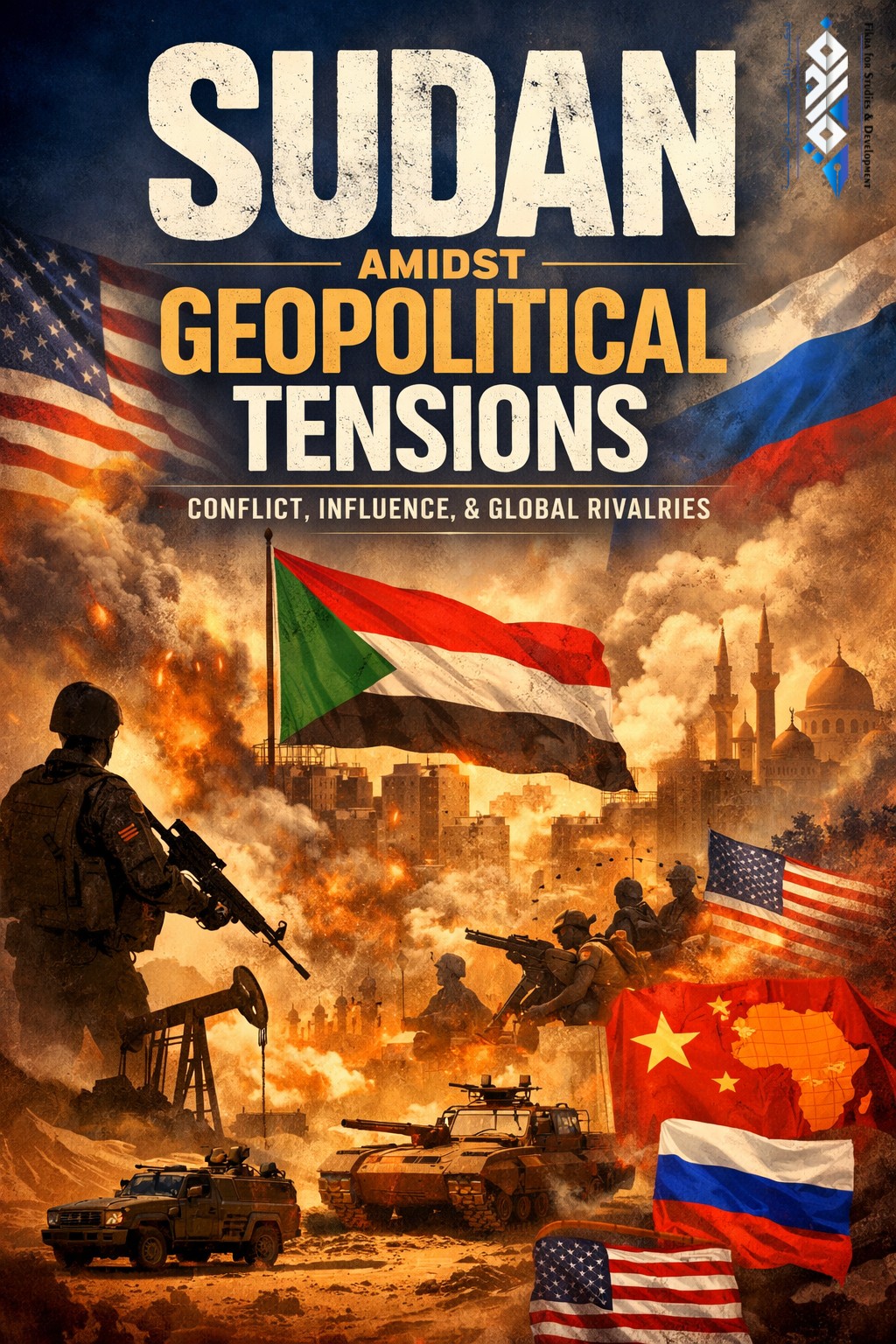
Sudan Amidst Geopolitical Tensions
Dr. Elshafie Khidir Saeid
Sudan possesses a uniquely strategic location, serving as a vital African gateway to the Red Sea with a coastline extending approximately 850 kilometers, and acting as a bridge linking the Horn of Africa, Central Africa, and the Arab world. While this strategic position might logically be considered an asset, it has, in present reality, transformed into a liability for several reasons. This location has rendered Sudan a pivotal element in the designs to redraw the regional map, in line with the “New Middle East” project, thereby increasing the likelihood of its fragmentation into independent states—a process that began with the secession of the South. Moreover, it situates Sudan within an area of profound geopolitical tensions, marked by conflicts related to Red Sea security and intense international competition over its waterways and global trade routes. It also heightens the risk of the country’s bloody conflict spilling over into neighboring states, especially those already grappling with escalating political and social tensions and fragile security situations. Certainly, this geopolitical significance draws the attention of international and regional powers to Sudan, yet this attention complicates its internal crises, as external interests intertwine with local conflicts, rendering the ongoing war, in part, a proxy war.
We are not presenting anything new by highlighting these geopolitical realities, as they are evident and clear to any observer. However, we have recounted them as a prelude to a question we pose and contribute to answering in today’s article: In light of the current regional and international tensions, can Sudanese civil forces operate in isolation from these geopolitical facts? Our direct answer is no. On the contrary, they can develop aclever strategy that leverages this geopolitical reality and these international interests for the objective of stopping the war. This can be achieved by adopting and implementing a number of measures, some of which we propose:
First, harnessing geostrategic interest to serve peace by presenting a vision of a stable Sudan as a factor for regional stability rather than a hub of threat. This involves highlighting the risks a fragmented Sudan poses to international maritime security and the national security of neighboring countries, and persistently emphasizing the links between the continuation of war and the escalation of cross-border and transnational threats, such as human trafficking, organized crime, arms trade, etc.
Second, implementing a multi-level action program. Internally, this could include forming “local reconciliation councils” among ethnic groups and tribes directly affected by the conflict, establishing a “community observatory” to document violations and provide reliable information that enhances accountability of warring parties, launching “joint humanitarian initiatives” that cross frontlines to deliver aid, etc. Regionally, it could involve forming “community and popular delegations” to clarify the Sudanese people’s stance on the war to neighboring countries, developing a “policy paper” on neighboring countries’ interests in Sudan’s stability, and holding dialogues with civil society in influential states—a proposal we discussed in a previous article. Internationally, instead of merely waiting for and commenting on others’ initiatives, civil forces should take the lead in formulating a “Sudanese Peace Initiative” to present to the international and regional community. They could propose its discussion within a Sudanese-International Peace Coordination Council, comprising representatives from Sudanese civil forces, the United Nations, the African Union, the European Union, and the Arab League. They could also establish a “unified communication mechanism” with international organizations to avoid conflicting representation, and design and develop relief and recovery plans based on the priorities of local communities.
Sudanese civil forces could also exploit international competition in the Horn of Africa and the Red Sea, positioning Sudan as a laboratory for international and regional cooperation rather than rivalry, or inviting competing powers to participate in a neutral “humanitarian alliance.” They could propose forming joint monitoring teams with international observers and creating a unified information platform and a shared aid database to prevent duplication and contribute to transparency. Furthermore, they could demand that any peace fund proposed by international conferences and donor meetings be conditional on linking international aid to the warring parties’ commitment to tangible steps toward peace. In the same context, and by utilizing UN reports as pressure tools on the warring parties, I believe civil forces should mobilize their legal professionals to explore how to leverage the international legal framework to provide civilian protection under the “Responsibility to Protect” principle and resort to international mechanisms for holding human rights violators accountable.
In summary of the above discussion regarding Sudan’s strategic location at the heart of geopolitical tensions, what is required today is a “new social contract” between Sudanese civil forces and the international community. This contract should be based on partnership rather than guardianship, mutual accountability rather than unilateral conditions, and a shared vision of Sudan as a stable state contributing to regional security rather than threatening it. Above all, it requires the international community’s conviction that Sudan’s future is determined by the Sudanese people themselves. In short, in a time where regional and international crises intersect, Sudan holds a historic opportunity to transform its geostrategic position from a curse that complicates the conflict into a blessing that attracts genuine international support for peace. However, this opportunity will not materialize without civil forces that are unified in vision, effective, and presenting a clear action program, and an international community that realizes that investing in Sudan’s peace is an investment in the stability of a region of critical importance to its interests.
Admittedly, this proposed activity faces many challenges in the current international context, such as the international community’s preoccupation with multiple crises, the conflict of its interests in the Red Sea region, and the risk of Sudan becoming a “forgotten crisis” in international media. However, conversely, there are many opportunities, such as neighboring countries’ interest in Sudan’s stability to protect their own interests, the international need to ensure the security of navigation in the Red Sea, and the possibility of leveraging international historical experience in conflict resolution, among others. What I wish to say is that the role of Sudanese civil forces cannot be separated from the complex geopolitical context. But the success of this role requires these forces to transition from the position of spectators or recipients of initiatives and aid to active partners in peacemaking. Prior to that, it requires their unity in visions and stances—not necessarily in a structured organizational framework, as I discussed in a previous article.