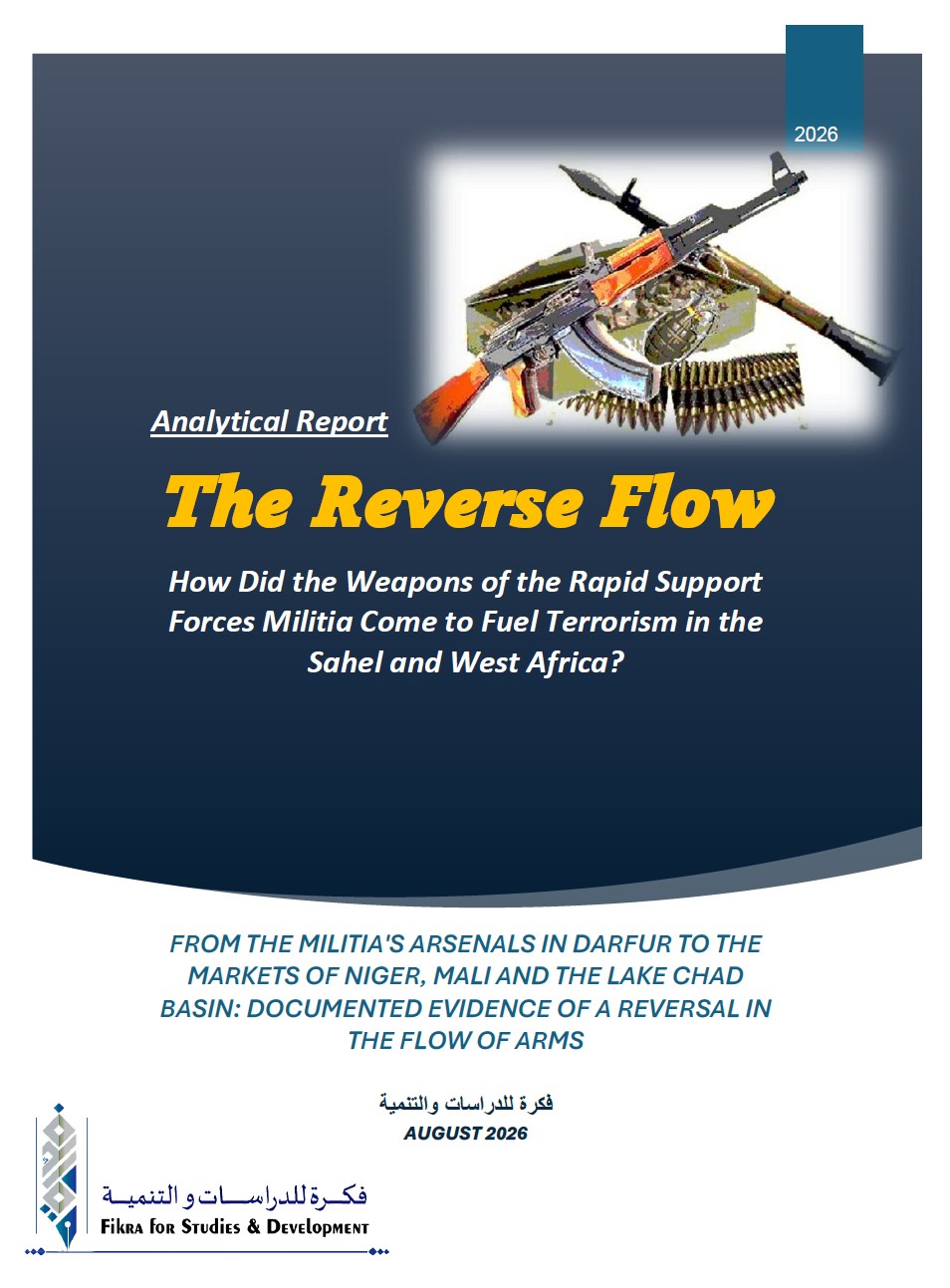
The Reverse Flow: How Did the Weapons of the Rapid Support Forces Militia Come to Fuel Terrorism in the Sahel and West Africa?
19 August 2026
Fikra for Studies and Development announces the publication of its latest analytical report:
The report provides extensive documentation of how Sudan’s ongoing war has evolved from an internal conflict into a regional engine of arms proliferation, reshaping security dynamics across North Africa, the Sahel, and West Africa.
Key Findings
- Documented Proliferation of RSF Weapons
The report presents documented evidence that weapons and advanced military technologies originally supplied to the Rapid Support Forces (RSF) militia are reaching armed, jihadist, and terrorist groups across the Sahel and West Africa through networks of trafficking, resale, and redistribution. United Nations investigations and field research have traced specific cases of RSF-linked weapons and ammunition reaching groups including the Islamic State in the Greater Sahara (ISGS) and Jama’at Nusrat al-Islam wal-Muslimin (JNIM).
- A Qualitative Shift in the Nature of the Threat
The proliferation risk is no longer confined to conventional weapons. It increasingly involves advanced military technologies capable of significantly enhancing the operational capabilities of non-state armed groups. The report documents information concerning the transfer of 25 drones from Sudan to the Islamic State West Africa Province (ISWAP), alongside a sharp increase in the use of drone technology by the RSF militia in attacks across the region. This represents a dangerous qualitative shift in the military capabilities available to non-state armed groups.
- Libya: From Transit Corridor to Strategic Logistics Hub
Libya has evolved from a transit corridor for weapons and fighters into an advanced logistical base for RSF operations, including vehicle modification, fighter assembly, and the redistribution of weapons toward markets and conflict zones across the Sahel.
The report also documents a significant increase in cargo flights into Kufra, following a decline in the use of the Am Djarass route for supplying the RSF militia. This shift demonstrates the adaptability and resilience of these supply networks, which continue to reorganize and operate through alternative routes despite restrictions on arms movements.
- Mercenary Recruitment and the Movement of Fighters
The report documents the recruitment of hundreds of Colombian military contractors through networks based in Abu Dhabi and transiting through Emirati military facilities and bases. This has added a further international dimension to the Sudanese conflict and expanded the scope of its cross-border consequences.
- The War Economy and the Incentives Driving Arms Trafficking
Arms trafficking is driven not only by military considerations but also by powerful economic incentives. Weapons are acquired at relatively low prices near conflict zones in Darfur and subsequently resold at significantly higher prices in Libya and the Sahel.
Payments are reportedly made in some cases through gold, fuel, vehicles, or narcotics, while satellite communications are used to coordinate convoys and transport operations across vast distances.
The report further assesses that the involvement of RSF commanders in the diversion and redistribution of weapons is motivated not only by financial gain, but also by efforts to build networks of influence and relationships with like-minded armed groups across the Sahel and West Africa.
From this perspective, weapons diversion is not merely an opportunistic extension of the war economy. It may also constitute a mechanism for building cross-border relationships and networks that could become sources of influence, leverage, and future support for these commanders.
The report warns that continued replenishment of the RSF’s military arsenal, in the absence of effective mechanisms for arms control and tracing, is likely to amplify this behavior, expanding the capacity of these networks to recycle, redistribute, and transfer weapons to other armed groups across the region.
- Strategic Risks and Policy Recommendations
The report warns that any ceasefire or political settlement in Sudan that is not accompanied by effective arrangements for disarmament, the dismantling of the militia, and strengthened border controls risks triggering a wider flow of weapons and fighters into neighboring countries and the broader region.
The report calls for urgent international action to:
- Designate the RSF militia as a terrorist organization and treat its networks as cross-border security threats;
- Strengthen mechanisms for tracing weapons and ammunition and documenting their origins and transfer routes;
- Tighten enforcement of arms embargoes and oversight of weapons supply networks;
- Prioritize measures to prevent the proliferation of advanced military technologies, particularly drones; and
- Strengthen regional cooperation to prevent Sudan from becoming a sustained source of weapons and military technology for armed groups across the Sahel and West Africa.
Read the Full Report
About Fikra for Studies and Development
Fikra for Studies and Development is a non-partisan Sudanese thinktank and research organization committed to producing rigorous, evidence-based analysis on security, development, and public policy issues affecting Sudan and the wider region.
This report forms part of Fikra’s continuing efforts to identify emerging threats, provide policymakers, civil society, and the international community with evidence-based analysis, and support more effective and coordinated responses to the cross-border challenges generated by the war in Sudan.
For Media Inquiries
Fikra for Studies and Development
Email:info@fikrasd.com
Website: www.fikrasd.com