Paradoxes and Contradictions Fueling the Sudan War
Dr. Elshafie Khidir Saeed
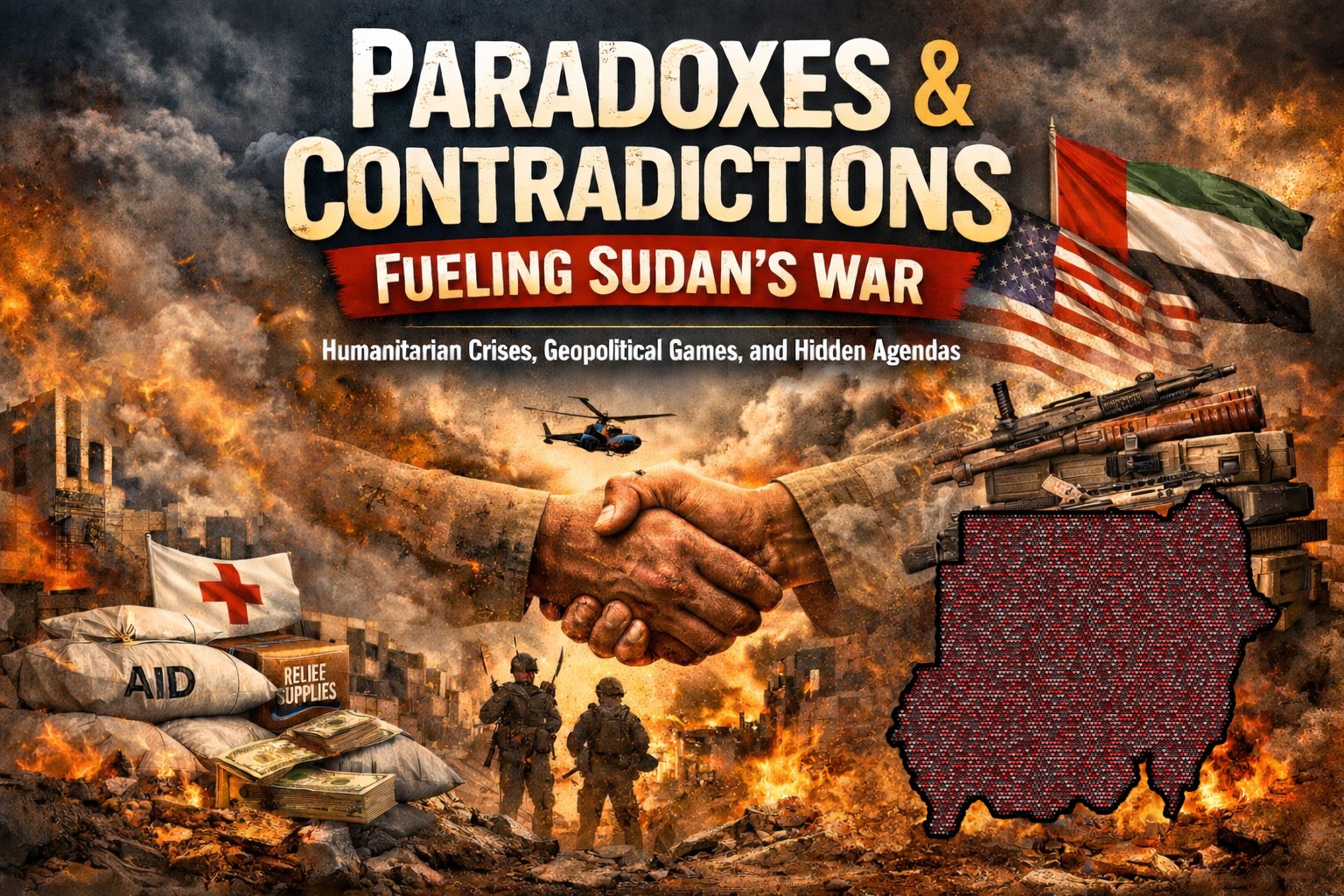
The prevailing consensus regarding the ongoing war in Sudan, which erupted in April 2023, is that it represents one of the most complex humanitarian crises of the modern era. This consensus holds firm regardless of the varied perspectives from which one approaches the conflict’s details; all paths lead to the same conclusion. In this article, however, we focus on a specific angle: the war has evolved into a theater of stark international and regional paradoxes, revealing the profound disconnect between official humanitarian and political rhetoric and the actual geopolitical practices on the ground. For the purposes of this discussion, we limit ourselves to two such paradoxes, through which we aim to illuminate the contradictions between regional and international discourse and tangible actions in the field.
The First Paradox: While international conferences proliferate under the banner of supporting Sudan and providing relief to its civilian population, the tragedy of these civilians deepens, and the scope of destruction expands, without any genuine indicators of a serious international will to staunch the bloodshed. To date, three major international conferences have been convened under the auspices of humanitarian aid for Sudan: the Paris conference in April 2024, the London conference in April 2025, and the Washington conference held at the beginning of this February. The profound irony lies in the fact that the Paris and London gatherings, despite their ostentatious humanitarian slogans, achieved no substantive breakthrough in halting the war or even protecting civilians—and I do not anticipate that the Washington conference will deviate from this pattern. These events have devolved into mere diplomatic rituals, devoid of substance, where grandiose figures for humanitarian support are announced amid media applause, even as the war rages with unabated ferocity.
If the Paris conference marked the inaugural effort in this series, why have subsequent conferences failed to draw lessons from its evaluation? And why should we expect the upcoming Berlin conference, slated for April, to yield a different outcome? The reality is that these conferences perpetuate a flawed model predicated on proclamations of pledges without effective implementation mechanisms, oversight, or linkages between humanitarian aid and genuine political pressure on the conflicting parties. Although participating nations have declared billions in funding, the actual impact on the ground remains negligible, as much of this money either remains unfulfilled promises or is repurposed as tools for political leverage and bargaining, rather than authentic relief for desperate populations.
The Second Paradox: This is a glaring ethical contradiction, and perhaps the most painful, manifested in the fact that some of the very nations pledging vast sums for humanitarian aid in these conferences are the primary backers of the warring factions. At the recent Washington conference, the United Arab Emirates announced a pledge of $500 million, in addition to a prior balance of $800 million, for humanitarian support since the war’s outbreak. Yet, on-the-ground realities confirm that the UAE serves as the principal supporter of the Rapid Support Forces, rendering its declared contribution akin to publicly advocating for extinguishing a fire while secretly stoking its flames. This duplicity is not unique to the UAE; it extends to numerous regional and international states engaging in systematic political hypocrisy, publicly calling for a ceasefire on humanitarian grounds and committing substantial funds to civilian protection, all while flooding Sudan’s battlefields with their weapons and munitions.
How are we to interpret these stark paradoxes and contradictions? Several factors may aid our understanding:
First, the war in Sudan appears to have become an arena for settling regional and international scores, where each power seeks to bolster its influence and safeguard its interests in a nation possessing a strategic location and immense natural resources.
Second, certain actors may aim to transform humanitarian aid into an instrument of control and leverage, deploying it to secure loyalties and forge alliances rather than as unadulterated assistance for the needy.
Third, these international conferences may serve as a moral veneer for some donor nations, polishing their global media image while their policies of supporting conflict parties continue covertly.
Fourth, select international and regional powers may prefer the war’s continuation within controlled bounds, as instability keeps Sudan weakened and facilitates the exploitation of its resources at minimal cost. In a prior article of ours from March 2024, we documented indicators of this dynamic, including: the persistent influx of arms to both sides without any intent or initiative from capable global entities to impose an embargo; Sudan’s lands, rich in globally coveted precious minerals, but perhaps more critically, its fertile soil and abundant water resources positioning it as a potential solution to the current global food crisis projected to peak by 2050; and a 2004 report from the Washington-based Center for Strategic and International Studies, titled “Sudan After Peace,” which described Sudan as a failed state requiring reconfiguration and replacement through land acquisition, even by proxy. Thus, prolonging the war sustains this failure, potentially leading to Sudan’s fragmentation and partition among multiple states. Furthermore, Sudan occupies a pivotal role in the “New Middle East” project aimed at redrawing the region into smaller entities, and reluctance to end the war advances this scheme.
The fundamental question remains: Do international and regional powers genuinely desire to halt the war in Sudan, or do their geopolitical and economic interests supersede the fate of the Sudanese people in priority? Has the war indeed become a lucrative enterprise for some, a field for influence for others, and a source of political pressure for all? What Sudan requires is not more performative conferences or hollow humanitarian pledges, but an authentic political will from the international community to enforce a rigorous arms embargo, hold accountable those nations fueling the conflict, and tie humanitarian aid to verifiable guarantees for ceasing hostilities. While every war eventually ends, the tragedy lies in the fact that some conflicts persist until external parties extract all they desire, leaving the people and the nation to bear the full cost.