
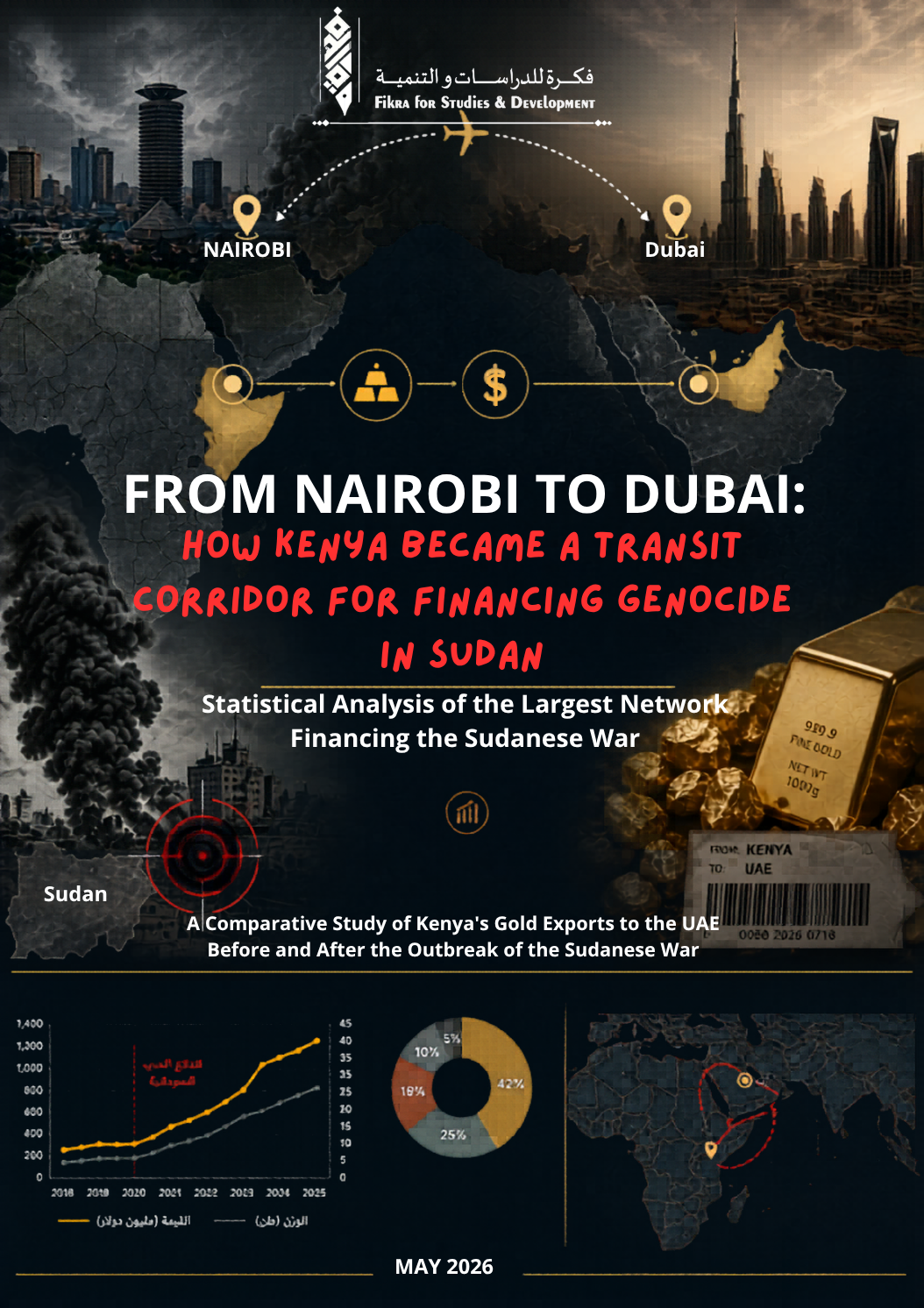
From Nairobi to Dubai: How Kenya Became a Corridor for Financing Genocide in Sudan
FIKRA FOR STUDIES AND DEVELOPMENT
From Nairobi to Dubai: How Kenya Became a Corridor for Financing Genocide in Sudan
Statistical Report on the Largest Network Financing the Sudanese War
24 May 2026
These Are Not Commercial Transactions — They Are a Structure for Financing Genocide
Fikra for Studies and Development (FikraSD) publishes its analytical report titled “From Nairobi to Dubai: How Kenya Became a Corridor for Financing Genocide in Sudan“ — a data-driven investigation into one of the most significant financial and commercial networks linked to the war economy in Sudan. Through a comparative statistical analysis of Kenyan gold exports to the United Arab Emirates before and after the outbreak of the Sudanese war, the report examines the patterns, transformations, and structural distortions that raise urgent questions about cross-border gold flows, conflict financing, and the international economic architecture enabling and sustaining violence in Sudan. This publication is part of FikraSD’s ongoing commitment to producing evidence-based research on the Sudanese conflict, the political economy of war, accountability pathways, and policy responses.
The report presents a documented statistical analysis of Kenyan gold exports across two distinct periods: before the outbreak of the Sudanese war in April 2023, and after. It draws on five source layers of graduated reliability — from Kenya National Bureau of Statistics (KNBS) data, to UAE import records documented in the UN Comtrade Database (the “mirror data”), to reports by SWISSAID, the Global Initiative Against Transnational Organized Crime (GI-TOC), and the British institute Chatham House. The central finding is not a probability nor a hypothesis, but a statistical proof rising to the level of conclusive evidence that Kenya has become a structural hub in the network financing Sudan’s genocidal war, through the gold of the Rapid Support Forces (RSF) militia and the UAE network that supports it.
The report documents a major surge in the volume and value of Kenyan gold exports after April 2023 — a surge that cannot be explained statistically by a rise in Kenya’s domestic production (which in fact declined). A sharp temporal correlation marks the statistical leap with the outbreak of the Sudanese war (r ≈ +0.88, p < 0.03). A comparison of mirror data documented in the UN Comtrade Database against Kenya’s official export declarations reveals a gap — in both volume and value — exceeding seventeenfold in some years. These are cross-referenced pieces of evidence leading to a single conclusion: Kenya has become a massive structural hub in the war-financing network, through RSF militia gold and the UAE network that supports it.
KEY FINDINGS
First: The Numbers Do Not Lie — The Shocking Leap
Before April 2023, the UAE recorded an average of 3.42 metric tonnes of gold annually from Kenya. After the outbreak of war in Sudan, that figure leapt to 28.05 tonnes annually — an increase of 719% in volume, more than eightfold. More shocking still is the leap in real market value calculated at global gold prices: from an average of $187 million annually before the war to $2.48 billion annually after it — an increase of 1,224%, exceeding thirteen times the pre-war level.
In 2025 alone, the UAE mirror data recorded 56.1 tonnes of gold as originating from Kenya, with a real market value estimated at approximately $5.4 billion — in a country whose official domestic gold production did not exceed 350 kilograms in that same year. To state it directly: for every single kilogram produced by Kenyan mines in 2025, the UAE recorded the import of 160 kilograms as Kenyan gold — indicating that gold from another source is entering Kenya and being re-exported through it. More staggering still, this gold does not leave Kenya through official channels and yields no benefit to the state treasury; the overwhelming majority is smuggled through informal corruption networks linked to the Kenyan authorities, generating no tax revenues or government dues — the scale of which is documented in the report’s second finding on the gap.
Second: The Great Gap — What Official Kenyan Records Conceal
Over the nine years preceding the Sudanese war (2014–2022), the cumulative gap between Kenya’s officially declared gold exports and the UAE’s recorded imports from Kenya reached 23.75 metric tonnes, with an estimated monetary value of $1.127 billion across all those years — a large figure, but one reflecting a chronic latent imbalance that regulatory systems silently tolerated. In the three years following the outbreak of war in Sudan (2023–2025), this gap exploded to 77.44 tonnes valued at $6.833 billion — meaning that three years alone produced a gap exceeding three times its accumulated total over nine full years.
The trajectory of escalation makes the picture clearer still: the gap reached 8.97 tonnes ($561 million) in 2023, then 16.86 tonnes ($1.295 billion) in 2024, then surged to 51.6 tonnes ($4.977 billion) in 2025 — a figure that by itself exceeds double the entire nine-year pre-war gap. The compound annual growth rate of the gap accelerated from 5.2% before the war to 139.7% after it, meaning that what gold-smuggling networks once needed 17 years to achieve is now achieved in a single year.
Third: The Conclusive Statistical Proof
Numbers alone may be open to interpretation. The data were therefore subjected to a rigorous battery of statistical tests, the results of which are decisive.
The first and most powerful of these tests is the Mann-Whitney U test, which returned U = 0 — meaning statistically that every single value recorded after the war absolutely exceeds every single value recorded before it, without exception across 27 possible pairwise comparisons. The exact probability value reached p = 0.00455, meaning the probability of this pattern occurring by chance does not exceed 0.455% — making it conclusive statistical evidence of a genuine structural difference between the two periods, not random fluctuation.
This is reinforced by the Cohen’s d effect-size coefficient, which reached d = 2.277 for the volume gap and d = 2.031 for the value gap. In statistical science, a value of 0.8 indicates a large effect, and 1.2 a very large effect; anything above 2.0 falls entirely outside the standard classification tables and is described in applied statistics literature as exceptional in the literal sense of the word. The statistical analysis confirmed that the mean annual value of the Kenya-to-UAE gold gap rose by +1,719% compared with the pre-war period.
Statistical conclusion: what occurred cannot be explained by rising global gold prices — which rise equally for all countries and do not account for a leap in physical weights — nor by growth in Kenyan production, which was in fact declining, nor by the gradual development of regional trade, whose growth rate was 3% before the war. The only variable that changed in April 2023, coinciding with this golden surge, is the outbreak of war in Sudan and the RSF militia’s seizure of vast gold-producing territories to finance the war.
Fourth: The Blood Triangle — Militia, Corridor, and Market
The structure this report reveals is not a commercial structure, but a war-financing structure composed of three parties:
- The Militia and Its Gold: After April 2023, the RSF militia seized vast mining territories. Chatham House reports estimate that revenues from Sudanese gold range between $400 and $600 million annually — converting gold into direct fuel for the genocide the militia has been officially designated as committing.
- Kenya and the Organised Corridor: Kenya appears in this data not as an innocent transit point, but as an active structural financial node in the war-financing chain. Gold whose origin cannot be explained by domestic production and which is not reflected in official records appears in Dubai as having come from Nairobi. The Kenyan treasury collects official taxes only on the meagre fraction that is declared, while gold is smuggled through private corruption networks linked to the Kenyan authorities. Against a real market value of $7.4 billion in transiting post-war gold, the treasury collected only approximately $440 million — meaning $6.99 billion passed outside the official channels of the Kenyan government into private corruption networks. The total cumulative gap for both phases approaches $7.7 billion, equivalent to approximately one trillion Kenyan shillings that could have funded broad infrastructure and social services.
- The UAE and the Final Market: Dubai does not appear in this equation as a neutral commercial centre, but as a final market that converts war gold into cash liquidity and political leverage. In 2024 alone, the UAE imported 748 tonnes of African gold, while SWISSAID recorded that it imported 18 tonnes from Chad and 9 tonnes from Libya in the same year — both documented exit points for gold controlled by the RSF militia. The UN Trade Database removed the UAE’s 2024 data on 4 November 2025, just four days after publishing it on 31 October 2025 — raising serious questions about political pressure to suppress information embarrassing to the UAE, against whom documented evidence of involvement in supporting and arming the RSF militia has been steadily mounting.
Fifth: Kenya Is Not an Innocent Intermediary — It Is a Partner in the War Economy
This report does not merely establish the financial flows of gold; it exposes the surrounding political structure that makes these flows possible and sustainable. The government of William Ruto was not neutral toward the Sudanese war — it actively aligned with the militia. Nairobi officially received RSF militia commander Mohamed Hamdan Dagalo (Hemedti) in January 2024, made Kenyan territory available for meetings of RSF leaders and their allies, and permitted the signing of a charter founding a parallel government — steps that amount in practice to granting political legitimacy to a militia charged with war crimes, crimes against humanity, and genocide, a designation the United States formally announced against the RSF in January 2025. Nairobi also became a quasi-official base for hosting the activities of political organisations loyal to Abu Dhabi, including their leaders, meetings, and conferences. But what the figures in this report reflect is that this was no free lunch: the Ruto government and its associated networks profit by millions — indeed by billions of dollars — from the continuation of the war in Sudan, by channelling militia gold into global markets, the UAE foremost among them.
The report documents the testimony of former Kenyan Vice-President Rigathi Gachagua, whom Ruto removed from office in October 2024. Speaking from inside the structure that handled the Sudanese file in Kenya, Gachagua directly accused Ruto of having commercial arrangements with Hemedti concerning Sudanese gold, stating that gold is moved from Sudan to Nairobi and then redirected to Dubai. He also stated that Ruto had personally asked him to facilitate a meeting with Hemedti before excluding him from it — reinforcing his conviction that the meeting had nothing to do with Kenya’s national interest. This testimony is not political opposition rhetoric; it is a political indication linking the financial gap proven by the data to the direction of Kenyan policy from the very apex of the power pyramid.
Kenya’s pattern of engagement with other regional conflicts reinforces this reading: Nairobi did the same in the Congolese file when it hosted a political-military coalition including the M23 movement, prompting Kinshasa to recall its ambassador from Nairobi and demand official clarifications. Kenya under Ruto has ceased to play the traditional role of regional neighbour; it has become a political and logistical platform for non-state armed forces waging conflicts in resource-rich states.
Sixth: Findings and Conclusions
This report proves, through figures, statistical tests, and cross-referenced evidence, a set of categorical conclusions:
Kenya is not merely a passive transit state in the corridors of Sudanese gold smuggling — it is an active structural partner in the Sudanese war-financing system. The statistically conclusive rise in gold flows through it, coinciding with categorical statistical significance with the outbreak of war and the deepening of the political relationship with the militia, nullifies any narrative of innocence or free-market growth. Every dollar of the $6.833 billion gap across the three years of war is part of an economy feeding genocide and granting it the capacity to continue.
The UAE — which seeks to portray its role in the Sudanese crisis as that of a mediator and advocate of a solution — is in reality the final market that converts the gold of killing into liquidity, leverage, and weapons. The documented mirror data on gold entering the UAE leaves no room for interpretation.
The Nairobi government, which presents itself as a regional actor and hosts the political conferences of the militia and of other political organisations linked to Abu Dhabi, simultaneously reaps the revenues of the gold smuggling that finances the perpetration of genocide and ethnic cleansing across its territory. This is a contradiction that diplomatic rhetoric cannot exonerate and that official Kenyan revenue figures cannot disguise. The data in this report document — with categorical statistical precision — that Kenya is not neutral in Sudan’s war, but profiting from it. Those who profit from genocide bear their share of its burden before international law and history alike.
The full report is available for download
For press enquiries, institutional requests, or further information, please contact:
Fikra for Studies and Development (FikraSD) Email: info@fikrasd.com Website: www.fikrasd.com X / Twitter: @fikra_SD