
The Narratives of the RSF and Its Allies
The Narratives of the RSF and Its Allies
Amgad Fareid Eltayeb
22 February 2026
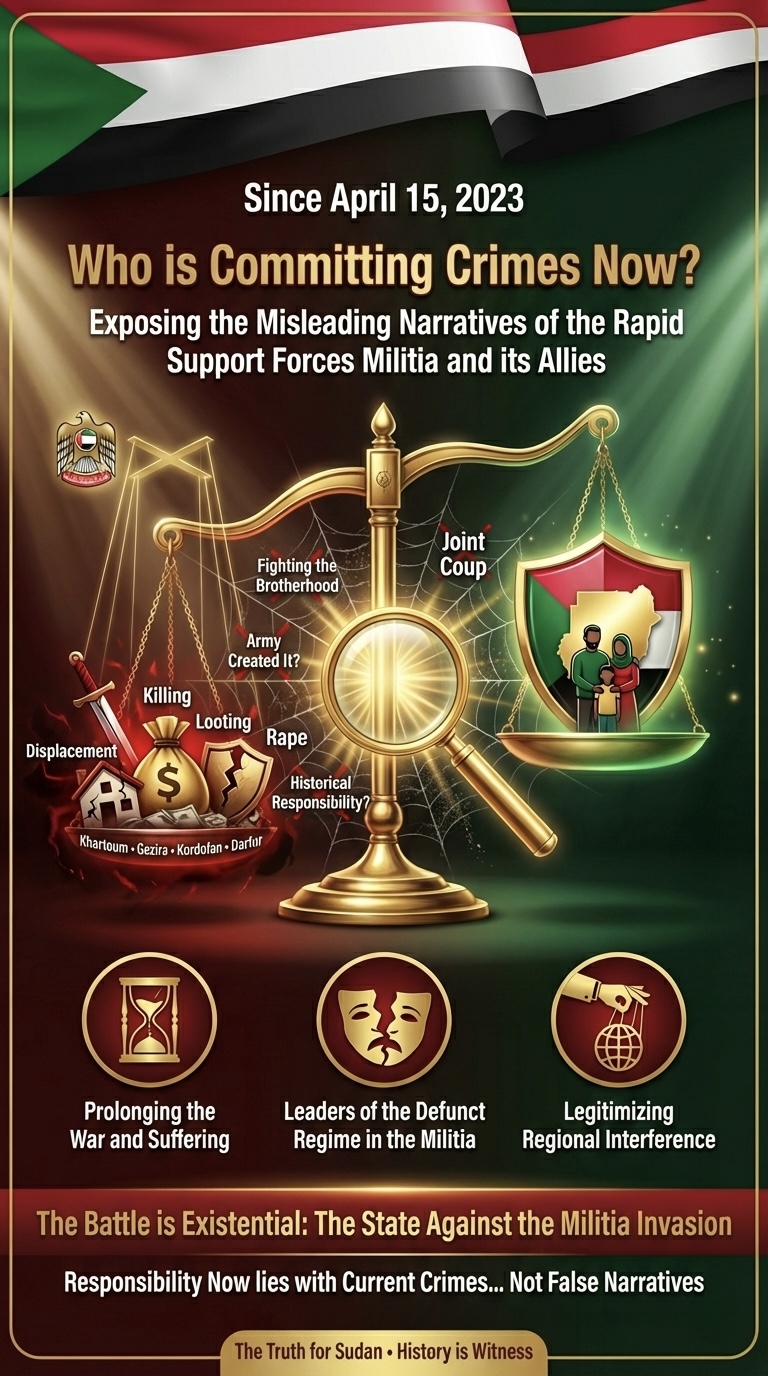
Since the outbreak of the war on 15 April 2023, civilian forces allied with the Rapid Support Forces militia have systematically promoted misleading narratives, inundating public opinion with a mixture of accurate and fabricated historical details. The objective of all such narratives is singular and unmistakable: to obscure the militia’s ongoing crimes and to legitimise its ambition to seize power by submerging the Sudanese crisis in a morass of contrived complexities that distract attention from the militia’s fascist character, its profound criminality, and its savage brutality.
None of these justifications bears any genuine relation to a principled stance toward the violations and atrocities currently being perpetrated against Sudanese civilians.
The peril of this alignment has not been confined to bolstering the militia’s political discourse; it has extended to three further, equally grave consequences:
- Prolonging the duration of the war and the suffering it entails through the systematic falsification and obfuscation of the conflict’s true nature.
- Furnishing political cover for the militia’s crimes by portraying its violations as components of a legitimate struggle, while criminalizing resistance to them and efforts to halt them.
- Legitimizing external intervention and serving as a cat’s-paw for regional powers—chief among them the United Arab Emirates—by supplying political pretexts for the continued arming of the militia and the perpetuation of Sudanese bloodshed, in addition to the overt defence of the UAE, which the world has unanimously condemned for its role in the shedding of Sudanese blood.
All of this constitutes far more than mere political misjudgement; it is a criminal immersion in the blood of Sudanese citizens being shed by the militia through murder, plunder, rape, and displacement—from Khartoum and al-Jazirah to Kordofan and Darfur, and in every locale reached by the militia’s hordes and mercenaries. The militia has repeated its crimes on an even larger scale and with greater savagery, yet these aligned civilian forces have consistently ignored them, for the narrative of falsehoods they propagate is indifferent to facts.
The central narrative advanced by the militia and its allies rests upon the claim that it is fighting the “Muslim Brotherhood.” This assertion collapses before the evidence. Those currently occupying the seats of government ascended in the wake of the December Revolution that overthrew Omar al-Bashir and consigned him to the prison where he now remains. They are the very actors with whom these same civilian forces shared power for more than two years. Did they suddenly become Muslim Brothers overnight, or does their alliance with Hemedti serve as the certificate of absolution from “Kizanism” and political Islam that the UAE requires? These are also the very parties with whom the aligned forces negotiated in pursuit of power-sharing under the banner of restoring the civilian democratic transition after the 2021 coup. Were they then conscripted by the Islamist movement, or is this merely a blackmail card and political overbidding intended to improve the terms of the Framework Agreement?
The fallacy of this argument is compounded by their invocation of the October 2021 coup—a political sin beyond dispute, yet one committed jointly and equally by the army and the Rapid Support Forces, at the instigation of the same regional patron, the UAE, which sought thereby to advance its own political agenda. Indeed, the Rapid Support Forces bore the largest share of financing, execution, and planning. How, then, can it be exonerated, or alignment with it and its patron be justified? The crime of that coup is shared; it cannot serve as a basis for moral differentiation between the army and the Rapid Support Forces—quite apart from the fact that the present battle is not about who governs the country, but about the fundamental rights of its people: to security, to sovereign national decision-making, and even to the elementary right to live in their own homes. It is precisely these rights that the mouthpieces of the aligned forces have cast into doubt while defending the militia’s occupation of civilian houses and justifies their continued seizure—until the army liberated them.
The supreme irony is that the ranks of the Rapid Support Forces today swarm with leaders of the Bashir regime and Islamists: Hasabu Abd al-Rahman, Vice-President under Bashir and Deputy Secretary-General of the Islamist movement; Taha Osman al-Hussein, director of Bashir’s offices, who quarrelled with the regime over details of corruption, despotism, and foreign agency rather than over political or ideological stance; Abd al-Ghaffar al-Sharif, notorious for his brutality as a National Islamic Front student-security cadre and director of Bashir’s political security; even al-Fatih Qurashi, the militia’s spokesman, and al-Basha Tabiq, who led the “Green March” demonstrations against the revolutionary government; and the opportunists whose hearts were “reconciled” by ministerial posts in Bashir’s final governments, such as Ibrahim al-Mirghani. Yet these facts alter nothing in the construction of the ideological fallacy propagated by the forces aligned with the militia under the patronage of the Abu Dhabi regime. A narrative built on lies remains a narrative built on lies.
Another fallacy cultivated by these forces allied with the militia under Abu Dhabi’s patronage is the attempt to assign the army responsibility for the crimes of the rebellious militia on the grounds that the army originally established it—even while the army is fighting it and seeking to neutralise it.
This claim is not only a flagrant lie; it contains a glaring logical contradiction: how can an entity remain responsible for a body that has entered into open warfare against it? In its effort to obscure rational analysis of the Sudanese scene, the claim disregards the fundamental legal principle that distinguishes “historical creation” from “effective control” and actual participation at the time the unlawful act is committed.
Under international and criminal law, responsibility arises only under one of two criteria: effective control over the acts at the moment of their commission, or knowledge, participation, incitement, or complicity.
It is legally absurd to hold any party accountable for the acts of an entity that was historically part of in the past let alone it has rebelled against it, openly declared hostility, and turned its weapons upon it, merely because that party once created it. Otherwise, Germany would remain responsible to this day for the Gestapo and the SS up until now—an assertion that contradicts the elementary foundations of responsibility, which rest upon actual attribution rather than institutional pedigree.
The greatest falsification in this narrative lies in the deliberate erasure of the original question: who created this militia, and why? The Rapid Support Forces did not emerge as a natural institutional evolution within the army. It was the product of a parallel security architecture engineered by Omar al-Bashir to protect his throne. It was formed under the supervision of his office director, Taha Osman al-Hussein (the Emirati agent later exposed), as a special force enjoying direct subordination to Bashir, outside the army’s chain of command, with a parallel leadership structure whose purpose was to counterbalance the army itself and forestall any potential move from within it. The army clashed with it repeatedly in well-documented incidents; Bashir himself widely referred to it as “my protection forces.” From its inception it was employed to suppress civilians, making its first public appearance in the September 2013 massacre in which more than two hundred peaceful demonstrators were killed. Its hand later extended to wreak havoc in Darfur and Kordofan through grave violations of international humanitarian law.
Even its formal regularisation in 2017 was not genuine institutional integration; its independence was preserved under Bashir’s direct patronage. And this occurred only after open tensions that culminated in the dismissal of two army chiefs of staff (Lt-Gen Imad Adawi and his predecessor Lt-Gen Mustafa Abu Eshar) and the Minister of Interior (Lt-Gen Ismat Abd al-Rahman) following confrontations with the militia.
The political creation of a parallel force, even by superior legislation, does not confer institutional legitimacy—especially when the regime that enacted it was overthrown by a massive popular revolution that stripped it of every remnant of legitimacy: executive, sovereign, and parliamentary. Any subsequent attempt to manage its legacy was merely an effort to deal with a de facto reality and to avert armed collision—an attempt that has now manifestly failed. Nevertheless, this does not absolve the current leadership of the armed forces, nor the civilian forces that participated in the transitional period, of direct and negligent responsibility for overlooking the danger posed by this militia and permitting its expansion.
In conclusion: even if we grant the existence of historical responsibilities in the engineering of this distorted situation, such responsibilities do not today justify alignment with the militia, adoption of its discourse, or concealment of its present crimes. Responsibility is measured by current realities, effective control, and legal attribution—not by propagandistic narratives or misleading generalisations. Any deliberate conflation of these levels is not analysis; it is a cheap attempt to redistribute crimes and to efface the true perpetrator.
The national position must rest upon the answer to a single question: who is committing the crimes now? Any serious national discourse today does not begin with “who erred first?” but with “who is committing the crimes now—and who supports them?”
The present battle is not between ideologies; it is an existential confrontation between the logic of the state with its institutions and the logic of militia conquest that aims to fragment the social fabric and plunder national resources. Every attempt to launder the militia’s crimes and justify them by demonising its opponents constitutes complete moral complicity. History will not forgive those who chose to become an echo of the murderer’s rifle or to provide political cover for the bullet that pierces Sudanese breasts.