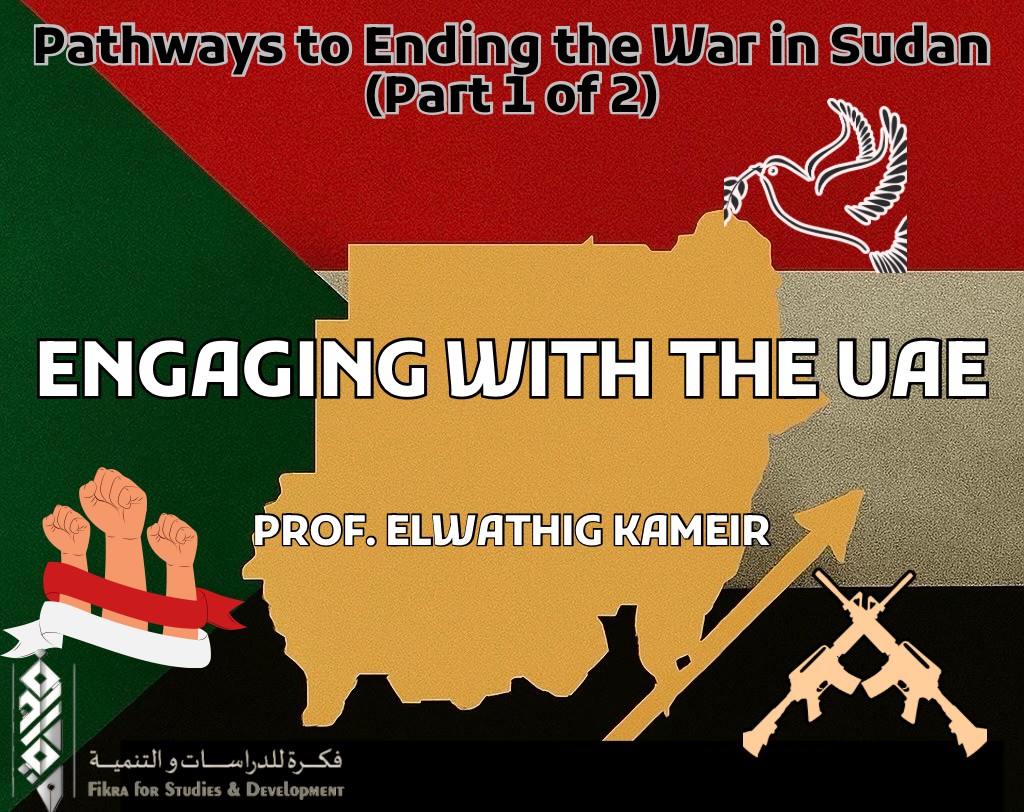
Pathways to Ending the War in Sudan (Part 2 of 2): Engaging with the UAE
Pathways to Ending the War in Sudan (Part 2 of 2)
Engaging with the UAE
Elwathig Kameir
Kameir@yahoo.com
Toronto, November 11, 2025
Introduction
Against the backdrop of sustained regional and international efforts to end the war—particularly the initiatives of the “Quad Committee” led by the United States, now entering its third year—the issue of negotiations between the Government/Army and the Rapid Support Forces (RSF) has become central to political discourse. It dominates written commentary, televised debates, and even informal social gatherings, despite the wide divergence of views. Alongside this growing focus on negotiations, questions persist regarding the role of the UAE, accused of direct aggression and material support for the RSF, and how Sudan should engage with it.
Since June 2025, the UAE has shifted from its earlier role of “Observer” in the Geneva talks (August 2024) to that of “Mediator” within the Quad Committee. This development has divided opinion: some reject the UAE’s involvement outright, citing its aggression and active support for the RSF, while others argue that its presence in the Quad can be leveraged to Sudan’s advantage.
With the above as background, I sought to broaden the scope of consultations on these two positions by discussing them with a wider circle of opinion leaders engaged in Sudanese political affairs, with the aim of identifying potential options that could serve the national interest. Building on these consultations, my purpose in this two-part article is to shed further light on interconnected issues, and to raise critical questions that may serve to stimulate objective debate and dialogue. Such engagement can help bridge divergent perspectives and enable Sudanese stakeholders to arrive at a consensual formula to halt and ultimately end the war.
In the first article, I highlighted the issue of negotiations between the Army and the Rapid Support Forces. In this second article, I turn to the question of how Sudan should engage with the United Arab Emirates.
How Should We Engage with the UAE?
The prevailing view emerging from my consultations is that Sudan must engage with the UAE, despite its aggression and widely documented support for the RSF through weapons, logistics, and fighters. Pragmatism dictates that dialogue with the UAE should be prioritized.
Beyond dismantling the RSF’s external alliances, Sudan needs the UAE in both war and peace—just as the UAE needs Sudan—under the principle of mutual interests and reliance. The strategic objective of the proposed engagement is to sever the lifeline connecting the UAE to the RSF.
The UAE operates according to its interests. Despite its aggression, it lacks the capacity to militarily occupy Sudan or impose direct rule. Even attempts to install a loyal government in Khartoum have failed. Yet the UAE retains its investments, projects, and privileges. Negotiations should therefore be largely confined to economic matters—ports, agriculture, mining—without allowing any discussion of Sudan’s internal affairs, such as how and who governs. If the UAE is sincere in its stated commitment to Sudan’s unity and sovereignty, it must abandon support for the existence of a parallel army, which undermines the Sudanese people aspiration for a single, unified national army. Sudan should also retain the right to demand compensation for war victims, estimated in billions of dollars.
In other words, engagement with the UAE regarding economic interests must be separated from any discussion about the Sudanese national political process. This includes separating its security concerns regarding potential Islamist influence from political interference. The government is aware of the UAE’s security concerns and fears of Islamist influence, which can be addressed through bilateral dialogue, but without granting it license to interfere politically in a direct fashion. Historically, the relationship between the UAE and the Islamist Ingaz regime passed through phases of tension and rapprochement; the core of the relationship was pragmatic and interest-based rather than ideological or doctrine based. The UAE thus opposes Islamists when they conflict with its interests and allies with or tolerates them if they serve its goals. Since 2015, wasn’t there political, economic, and military rapprochement between the UAE and the Ingaz regime? Didn’t it request the Al-Ingaz regime’s president to participate with army forces in the Arab Coalition led by Saudi Arabia and the UAE against the Houthis?
Some argue that engagement with the UAE should precede negotiations with the RSF. Despite its sponsorship of the RSF and its role in prolonging the war, Sudan must seek a middle ground with the UAE. The reality is that Sudan cannot wage direct military confrontation against the UAE, nor politically neutralize it. The UAE’s influence extends across the region, shaping the positions of countries that might otherwise support Sudan. Few states will sacrifice their interests with the UAE to side with Sudan.
If we look closely, the UAE’s position resembles that of Chad during the Darfur war (2003–2009), and of Ethiopia, Kenya, and Uganda during the civil war (1983–2005), when they hosted and opened camps for factions of the Sudan People’s Liberation Army (SPLA). Sudan did not sever ties with these countries or explicitly antagonize them. Instead, it pursued dialogue and diligent efforts to reach understandings with all of them. Indeed, negotiations that resulted in the Comprehensive Peace Agreement (CPA) were led by Kenya—the most hostile at the time. As long as the RSF’s lifeline flows from the UAE, engagement and negotiation with the UAE are essential to stemming this lifeline. If Sudan’s Government/Army is prepared to negotiate with the RSF, why not with the militia’s sponsor? If dialogue is possible with the “Bishops,” why not with the “Pope”?
As I previously noted verbatim during the Geneva talks: “The presence of the UAE as an observer does not harm Sudan, given its role as a stakeholder accused of fueling the war. The Geneva negotiations are not the venue to resolve bilateral relations, nor must Sudan withdraw its accusations—supported by evidence and international reports—of the UAE’s involvement, while demanding it bear the lion’s share of war compensation, reconstruction, and development. Participation in the talks allows Sudan to expose the UAE’s role, press the United States on its position, and demand immediate cessation of support for the RSF. The Geneva platform provides an opportunity to highlight the grave threat posed by hidden support for the RSF to Sudan’s stability and to regional security” (Elwathig Kameir, “The Sudanese Government Should Attend Negotiations in Geneva”, Sudan Transparency and Policy Tracker, 22 August 2024). The government’s miscalculation in boycotting Geneva—even after the visit of U.S. Special Envoy at the time, Tom Perriello, to Port Sudan and his bilateral meetings in Jeddah and Cairo with the government delegation —ultimately led to the UAE’s elevation from “Observer” to “Mediator.”
Ironically, while reviewing this draft, I came across a statement by Lebanese President Joseph Aoun: “Lebanon has no choice but to negotiate (with Israel)… and negotiation is not with a friend or ally but with an enemy, and the language of negotiation is more important than the language of warp (3 November 2025). This observation underscores a broader truth. Hostility between Lebanon and Israel has persisted since 1948, marked by cycles of confrontation and relative calm, yet never culminating in peace or normalization. By extension, the presence of hostility or aggression does not preclude negotiation with the United Arab Emirates.
From another perspective, negotiation between Sudan and the UAE could yield an arrangement reminiscent of the Nkomati Accord signed in March 1984 between South Africa’s Pretoria regime and Mozambique. Under that agreement, Mozambique pledged to cease support for the African National Congress (ANC), while Pretoria agreed to end its backing of the RENAMO insurgency. Similarly, Sudan and the UAE could pursue an understanding whereby the UAE withdraws support for the RSF, in exchange for Sudan addressing the UAE’s strategic concerns and interests. Although the two nations are not immediate neighbors, they can nonetheless establish a framework aimed at halting support for armed factions, in exchange for economic and political assurances and/or guarantees.
In this context, the United Arab Emirates must move beyond its current policy of denial. Despite mounting regional and international human rights reports, press investigations, and growing evidence, the UAE has consistently rejected allegations of involvement in supporting the RSF militia. The nature of its relationship with the RSF reflects a pattern comparable to the deployment of the Russian Wagner Group—an informal instrument advancing state interests in conflict zones while shielding the state from direct accountability. Such a strategy has drawn repeated international criticism and has significantly damaged the UAE’s reputation among broad segments of the global community. This trajectory underscores the urgent need for the UAE to reassess its approach and reconsider its position.
The UAE leadership may now be recognizing the erosion of popular esteem in countries where it has intervened in internal affairs, including Yemen, Libya, Syria, and Somalia. In light of mounting criticism and international pressure—particularly following the undeniable atrocities that accompanied the fall of El-Fasher—the Emirati leadership appears increasingly aware of its entanglement in the conflict. Recent remarks by Anwar Gargash, shared on his personal X platform, may represent the first implicit signal from a senior Emirati official of a willingness to reassess Abu Dhabi’s position, after months of official denial regarding military support for the RSF. As The Guardian observed, this constitutes a “rare moment of admission,” suggesting that the UAE is beginning to acknowledge that backing the militia has become both a political liability and a heavy moral burden.
Despite these considerations, it must be acknowledged that neutralizing the UAE militarily and politically presents a formidable challenge—one that is neither simple nor having assurances of success. Nevertheless, it remains a preferable course to the current perpetuation of hostility. The prospect of an “exit” strategy for the UAE, in relation to its support for the RSF, might have been more attainable had the balance of power shifted decisively in favor of the SAF, as appeared possible during earlier military developments this year. Yet the dynamics of the conflict have since evolved, and current assessments suggest that the UAE may have contributed to strengthening the RSF’s position during the 2025 dry season. While these evaluations remain open to debate, there is undeniable momentum behind the RSF’s military advance—though the pendulum could once again swing toward the SAF.
Naturally, any negotiation with the United Arab Emirates requires the involvement of a major state—or a coalition of states—capable of facilitating the process, supported by credible guarantors such as the United States, Saudi Arabia, and Qatar. Within this framework, the United States appears to hold the greatest leverage over the UAE, while the roles of Saudi Arabia and Qatar remain significant in any mediation effort. As the UAE’s principal strategic ally, Washington has a vested interest in reducing the pressure directed at Abu Dhabi. The American administration is particularly attentive to ensuring that criticism of the UAE does not become a point of contention exploited by Congress to challenge its broader regional policies. For this reason, U.S. mediation emerges as the most critical avenue for initiating discreet, back-channel negotiations between Sudan and the UAE—laying the groundwork for the UAE’s eventual participation as a true formal mediator.
At this stage, the Sudanese government requires substantial and reliable political support within the country to ensure the effective implementation of any outcomes achieved through back-channel negotiations facilitated by American mediation. Yet a critical question arises: why should the United Arab Emirates place confidence in Sudanese negotiators to deliver on such commitments, given the apparent internal divisions surrounding the issue of the UAE? This challenge underscores the importance of building broad-based consensus within Sudan, so that any agreement reached externally can be credibly upheld and supported domestically.
As an initial step, bilateral engagement should be preceded by a joint media declaration from both parties, aimed at halting media escalation and curbing negative mobilization.
High-level engagement with the UAE has already taken place, as evidenced by the meeting between Sudanese Foreign Minister Mouhieddin Salem and the Emirati Minister of State for Foreign Affairs Sheikh Shakhboot Al Nahyan, in Washington this past October.
In parallel, the Turkish initiative could be further mobilized as a complementary track of mediation. This possibility is reinforced both by President Trump’s recent praise of Turkish President Erdoğan and by the longstanding ties between Sudan and Turkey. Together, these factors position Ankara as a credible partner in supporting dialogue and facilitating constructive outcomes.
The Chairman of the Sovereign Council could discreetly maintain a line of communication with the leadership of the UAE, building on prior contact with the UAE President in July 2024. Through such engagement, he could reassure Abu Dhabi that its legitimate interests will be safeguarded by Sudan’s military and civilian institutions, and that bilateral relations can return to normal despite the harm caused by past support for the RSF. This assurance could serve as an incentive for the UAE to reconsider its current stance as a backer of the RSF, which will bring an end to the militia’s continued intransigence, once that support is withdrawn. Therefore, the UAE’s presence in the “Quad” may become an asset rather than a liability, by not dealing with it as a “mediator,” but engaging with it in the context of bilateral relations, which is what happened in Washington.
If the UAE seeks to secure its diverse interests through continued support for the militia, such a strategy may yield short- or medium-term gains. Yet, in the long run, it imposes profound moral and political costs that the UAE leadership may find increasingly unsustainable. By contrast, pursuing dialogue and strengthening bilateral relations offers a pathway to enduring strategic partnerships. Such an approach would enhance the UAE’s image as a stabilizing force, rather than one perceived as imposing influence that risks leading to scenarios of genocide, national partition—or, at worst, the dismantling of the state.
Conclusion
The purpose of publishing these two articles has not been to prescribe solutions, but rather to stimulate discussion and deepen dialogue among those committed to ending the war. By raising two issues that weigh heavily on the minds of stakeholders, the intention is to provoke serious debate and encourage reflection. The two topics addressed are tied to divergent political positions on fundamental matters, which makes it essential for political and societal forces—despite their differing orientations and alliances—to sit together for frank deliberation and responsible dialogue.
Without such dialogue, it is nearly impossible for these forces to formulate a shared or consensus vision capable of halting the conflict and ending the war. Narrowing the gaps in perspective requires serious engagement on several central issues: 1) the role and leadership of the Army, 2) the status and future of the RSF, 3) the position of Islamists in the next phase, and 4) the relationship with, and role of, regional and international actors
Only through constructive dialogue on these core questions can the foundations for a sustainable peace in Sudan be laid.
______
Prof. Elwathig Kameir
Prominent Sudanese academic, political analyst, and writer. He is known for his insightful contributions on issues of war and peace, civil-military relations, and democratic transition in Sudan. A former member of the SPLM, he documented his experience in the widely read series “My Journey with Mansour Khalid.” Kameir is recognized for his balanced, critical thinking and constructive dialogue on Sudan’s political future.