Pathways to Ending the War in Sudan (Part 1 of 2): Negotiations between the Sudanese Army and the Rapid Support Forces (RSF)
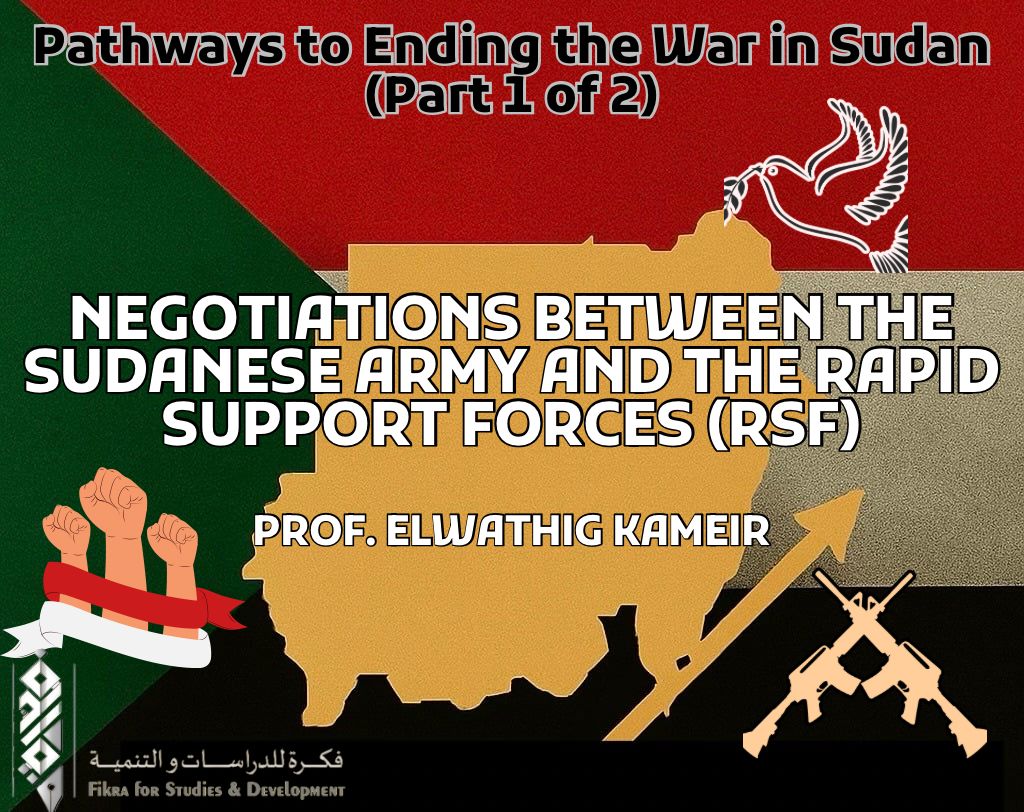
Pathways to Ending the War in Sudan (Part 1 of 2)
Negotiations between the Sudanese Army and the Rapid Support Forces (RSF)
Elwathig Kameir
Kameir@yahoo.com
Toronto, November 6, 2025
Introduction
Against the backdrop of ongoing regional and international efforts to end the war—led by the “Quad Committee”—now entering its third year, the issue of negotiations between the Sudanese Armed Forces (SAF) and the Rapid Support Forces (RSF) has become the central topic in political debates, media discussions, and even social gatherings, despite the wide divergence of views among interlocutors.
This growing focus on negotiations is accompanied by questions regarding the role of the United Arab Emirates (UAE), accused of aggression and direct support to the RSF, and how Sudan should engage with it. The UAE has shifted from being an “observer” in the Geneva talks that never materialized in August 2024, to assuming the role of “mediator” within the Quad since June 2025. Political opinion is divided: some reject the UAE’s mediation outright, branding it an aggressor, while others argue that its presence within the Quad could be leveraged in Sudan’s favor.
To broaden the scope of consultation, I posed these two key questions to a wide circle of politically engaged stakeholders, aiming to identify options that serve the national interest. Building on these consultations, this two-part article seeks to shed light on the two interrelated issues and to raise critical questions that may stimulate constructive dialogue and help bridge divergent perspectives—so that Sudanese themselves may arrive at a consensual formula to halt and ultimately end the war.
This first part focuses on negotiations between the Army and the RSF. The second part will address how Sudan should deal with the UAE.
Negotiations
Polarization has intensified among political forces, civil society, and opinion writers over the negotiations between the SAF and the RSF under the auspices of the Quad, led by the U.S. presidential Senior Advisor (Masada Boulos). This is manifested in his invitation to two delegations from the Army and the RSF to Washington, and in his shuttle diplomacy between the relevant countries. This polarization reflects a deep division in the Sudanese landscape: supporters view negotiation as an opportunity to end the war, while opponents regard it as an entrenchment of foreign custodianship and a whitewashing of the RSF’s crimes, especially following the fall of El Fasher and the horrific atrocities that accompanied it.
No one desires the continuation of war except its profiteers and brokers. Since mid-2023, despite the failure of the Jeddah talks, we have urged the government and the Army to participate in the Geneva talks (August 2024), stressing that negotiations should not be dismissed. Even in cases of surrender, as history shows (e.g., Japan), negotiations are indispensable.
Negotiations, however, must be guided by three fundamental principles:
- Defining the parties – Who negotiates with whom?
- Clarifying the agenda – What issues are on the table?
- Determining the endgame – What is the ultimate objective?
Following the Commander-in-Chief’s statement that the army is ready to negotiate “in a manner that serves Sudan, ends the war, and restores the country’s unity and dignity,” it is possible to achieve this goal by adhering to these principles:
1. Negotiating Parties
The negotiation track between the SAF and the RSF must be separated from the dialogue track among political and societal forces, and from engagement with the UAE and other external sponsors. In other words, the government should adopt a negotiation strategy for the security/military track, while pursuing dialogue strategies for the political and diplomatic tracks.
2. Negotiation Agenda
Talks between the government/army and the RSF should focus on dismantling the RSF’s institutional presence in all its military and economic dimensions. Crucially, the Dagalo family and RSF leaders must not retain any official political or military positions in the event of an agreement. The atrocities committed during the siege and fall of El-Fasher may well open the door to international and domestic prosecutions.
Indeed, the Prosecutor of the International Criminal Court (ICC) has already announced that his office is taking immediate steps to preserve and collect evidence of alleged crimes in El-Fasher for future prosecutions (ICC, 3 November 2025). He reminded all parties that, under UN Security Council Resolution 1593 (2005), the Court has jurisdiction over crimes committed in the Darfur conflict. These violations have severely weakened the RSF’s political and moral standing, sparking widespread outrage inside and outside Sudan.
Nonetheless, dismantling the RSF’s military presence will take time—whether during or at the end of the transitional period—particularly if the security arrangements protocol is implemented effectively.
The negotiation track must also address humanitarian issues: facilitating aid delivery, protecting relief convoys, ensuring civilian freedom of movement, and deploying human rights monitors in conflict zones. Only then should final security arrangements, including integration, be addressed—tasks that fall to the military institutions, encompassing the army and all armed movements without exception.
3. Negotiation Objective
The ultimate aim of negotiations must be to uphold security arrangements that prevent the re-emergence of any parallel military force, to resolve the question of a unified national army under a single command, and to build a professional army that excludes any political organization within it. This army must be subject to reform and modernization—alongside the broader security sector—while reflecting the country’s diversity.
This does not, however, imply depriving or preventing RSF leaders and personnel, who are not facing criminal charges or human rights violations, from their freedom to engage in political work according to the anticipated Law of Parties and Political Organizations after the conclusion of comprehensive security arrangements, as is the case for all armed movements.
The continued existence of two armies, alongside militias and armed groups, is a recipe for state collapse. The “two armies in one state” model enshrined in the Comprehensive Peace Agreement (CPA) led first to “two armies in two states” in 2011, and then to renewed war in South Kordofan and Blue Nile later that same year.
Why not form a political party that brings together the RSF’s political allies? The issues the RSF belatedly raised nearly two years into the war—historical marginalization, decentralization, restructuring of the Sudanese state, even secularism—are all matters to be debated in an all-inclusive Sudanese dialogue. Such a dialogue must exclude only those guilty of crimes and corruption, and must place constitutional foundations and state-building questions at the top of its agenda.
Questions for Reflection
- The roadmap the Sudanese government later submitted to the UN Secretary-General in April 2025, particularly its security and military provisions, appears more like a call for “surrender”—especially after the RSF formed the “Ta’sis” alliance and a rival “authority” (regardless of recognition), and after its capture of El-Fasher. Will the RSF engage positively with this plan, or reject it outright? Will it instead insist on negotiations between the government in Port Sudan and the Ta’sis authority in Nyala? More broadly, some political and “civil” forces envision negotiations among three blocs: pro-army, pro-RSF, and pro-peace.
If the government’s roadmap proves unworkable, what alternative option remains? A political settlement based on power- and wealth-sharing, as in past peace agreements? If so, what guarantees exist that such a settlement would not fail as its predecessors did—producing neither sustainable peace nor national unity, and this time risking not just partition but the disintegration of the Sudanese state?
- If the RSF agrees to military-to-military negotiations, will it accept to negotiate alone? Or will it insist on including its military allies—the SPLM-North and splinter armed groups that joined the Ta’sis alliance? If the talks are about a ceasefire, how will the government handle the RSF alongside these groups? Splinter factions may accept RSF representation, but the SPLM-North under Abdelaziz al-Hilu is unlikely to do so. In my view, al-Hilu’s movement will only negotiate with the government/army under two conditions: first, that the main objective is a comprehensive declaration of principles to govern the process; and second, that negotiations proceed in sequence—beginning with political issues addressing the roots of Sudan’s crisis, followed by humanitarian matters, and concluding with security arrangements and a comprehensive ceasefire.
- The same question applies to the government and army: do the armed movements fighting alongside the army in the Joint Force share a unified position on negotiations, and on the Quad’s composition—particularly the UAE’s presence? Conversely, the RSF will not accept negotiations with the SAF if accompanied by the Joint Force.
- Another question: if the army and RSF agree to a temporary ceasefire, how will it be enforced on the ground? Despite the RSF’s central leadership under Hemedti and his brother, credible reports indicate that some field units act independently, driven by local realities, tribal loyalties, and economic interests (such as control of mining areas or supply routes). This fragmentation complicates the implementation of ceasefire orders, as units may disregard directives if they perceive the agreement as undermining their immediate interests or local power.
On the other side, after El-Fasher’s fall, large numbers of armed movements w’ forces within the Joint Force withdrew and redeployed to scattered areas, making adherence to a ceasefire risky and difficult. Politically, some forces are exploiting El-Fasher’s fall to widen rifts between the SAF and the Joint Force, potentially deepening fractures within the pro-army political-military bloc.
- The Chairman of the Sovereignty Council had previously accepted a one-week truce proposed by the UN Secretary-General (June 27), while the RSF rejected it. However, the humanitarian ceasefire offered by the Quad as part of a three-step roadmap may prove difficult to accept or implement under conditions of sustained military pressure, ongoing operations in Kordofan and Darfur, RSF control of El-Fasher, and continued support and supplies provided from neighboring states. While the continuation of war without a “truce” risks aggravating and expanding the already dire humanitarian catastrophe—potentially weakening the army’s international standing—the army’s acceptance of such a ceasefire would be conditional upon halting RSF troop I movements, strict international guarantees preventing any redeployment, and the establishment of a credible field monitoring mechanism.
Amid intense anticipation from observers, Sudanese society, and the international community, the Sudan’s Defense and Security Council convened an important meeting to discuss the current situation, particularly the humanitarian truce proposed by the Quad mediation. Yet the statement issued after the meeting was terse and made no mention of the truce or the mediation plan. It merely announced the formation of a committee to examine ways of alleviating humanitarian suffering and expressed gratitude to the United States for its efforts—without taking a clear position on the initiative. This omission generated confusion and divergent interpretations in political and media circles, especially following optimistic remarks by the U.S. President’s senior advisor, who suggested that the two sides were close to signing a ceasefire agreement. Some believe the Council’s statement was intended to avoid direct confrontation with Washington, given mounting international pressure to secure a ceasefire. Others argue that the government is still weighing the conditions for accepting the Quartet’s proposal, amid internal divisions among political forces over the plan’s viability.
In conclusion, the army truly faces a complex and difficult equation. For its leadership, the challenge is not only military but also political and popular. The army understands that any step perceived as a “concession” could erode its domestic support. Its reluctance toward a truce is not merely due to fears that the RSF would exploit it to consolidate power and secure military and logistical supplies—the militia captured El-Fasher without needing such a truce. Rather, in my assessment, the hesitation stems from the fact that a truce could pave the way for a permanent ceasefire that would entrench and legitimize RSF control over vast areas of Darfur and Kordofan, thereby weakening the government’s position in any forthcoming negotiation.
__________
Prof. Elwathig Kameir
Prominent Sudanese academic, political analyst, and writer. He is known for his insightful contributions on issues of war and peace, civil-military relations, and democratic transition in Sudan. A former member of the SPLM, he documented his experience in the widely read series “My Journey with Mansour Khalid.” Kameir is recognized for his balanced, critical thinking and constructive dialogue on Sudan’s political future.